
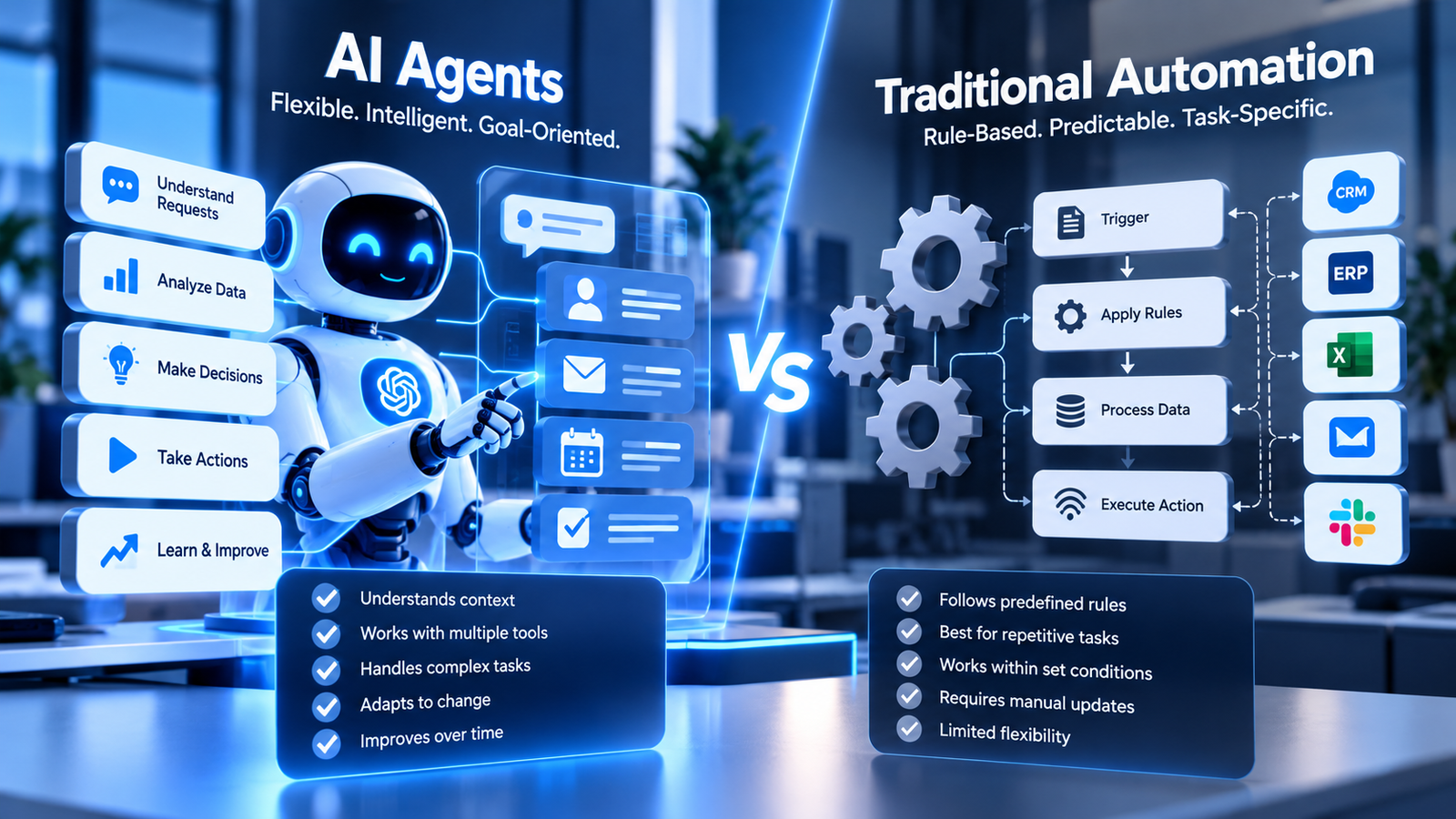
Artificial intelligence is changing the way businesses approach automation. But not every business task requires an AI agent, and not every automation should rely on a language model.
Understanding the difference between AI agents and traditional automation helps companies choose solutions that are reliable, maintainable, and appropriate for the work they need to perform.
What Is Traditional Business Automation?
Traditional automation uses defined rules, triggers, conditions, and actions to execute a process.
For example, when a customer submits a website form, an automated workflow can validate the data, create a CRM record, assign a salesperson, and schedule a follow-up task.
The process follows predefined logic. Its behaviour can usually be tested against known inputs and expected results.
What Is an AI Business Agent?
An AI business agent is a software system that uses AI capabilities to interpret information, select from permitted actions, and complete defined tasks within an operational workflow.
Depending on its design, an agent may read documents, summarize customer communications, classify incoming requests, retrieve information from approved sources, or interact with connected applications.
An AI agent should not be confused with a basic chatbot. A chatbot primarily supports conversation, while an integrated business agent may also interact with tools and perform approved workflow actions.
AI Agents vs Automation: The Main Differences
Predictability
Rule-based automation is generally preferable when a process can be expressed through clear conditions and requires consistent results.
AI systems can handle less structured information, but their outputs may vary. Validation and monitoring become especially important.
Type of Information
Traditional workflows work well with structured records, defined fields, and predictable events.
AI capabilities can help interpret natural-language enquiries, long documents, emails, and other information that does not arrive in a fixed format.
Implementation and Operating Costs
Both approaches require process analysis, integration, testing, and maintenance.
AI solutions may introduce additional model usage costs, evaluation requirements, data protection considerations, and operational monitoring.
Business Control
Traditional automation follows configured decision rules. AI-assisted processes require careful limits around the information they access and actions they can perform.
For sensitive or commercially significant activities, human approval may be necessary.
When Traditional Automation Is the Better Choice
- Synchronizing records between business applications.
- Creating tasks when defined conditions are met.
- Transferring validated data between systems.
- Generating reports from structured databases.
- Sending approved operational notifications.
These processes do not automatically become better because AI is added.
When AI Can Add Real Value
- Understanding free-text customer requests.
- Extracting relevant information from varied documents.
- Summarizing long customer histories.
- Finding answers in approved internal knowledge sources.
- Preparing drafts for employee review.
- Supporting complex information-gathering workflows.
Why Hybrid Architecture Often Makes Sense
For many business requirements, the useful design is not AI instead of automation. It is AI within a controlled automation architecture.
Consider an incoming customer email. An AI component can interpret the request and extract relevant fields. A deterministic workflow can then validate those fields, check customer records, apply routing rules, and create a task.
If the AI output is uncertain or the request is sensitive, the system can request human review.
This separates flexible interpretation from controlled execution.
Questions to Ask Before Building an AI Agent
- What specific business task must the system complete?
- Which parts of the process are already governed by clear rules?
- What information must the system access?
- Which external actions may it perform?
- How will errors and uncertain outputs be handled?
- What requires employee approval?
- How will quality, operating costs, and business value be evaluated?
How FEELINNOVATIONS Designs AI Business Systems
FEELINNOVATIONS develops custom AI agents, intelligent assistants, and connected business automations around defined operational requirements.
Our approach is technology-driven but not technology-dependent: we select the appropriate combination of software, business rules, API integrations, Python services, n8n workflows, and AI capabilities for each use case.
The goal is a maintainable business system, not an AI demonstration that cannot be reliably operated.
Choose the Architecture That Fits the Task
Traditional automation offers control and consistency for structured processes. AI provides additional capabilities for interpreting information and supporting more flexible workflows.
The strongest solution is the one that meets the actual business requirement with an appropriate balance of reliability, cost, and operational control.
Explore our AI Business Agents & Assistants solutions to see how custom AI capabilities can connect with real business workflows.