
Custom Business Software & Systems Integration
- Home
- Custom Business Software & Systems Integration
Solution Information
Solution Type: Custom Software & Systems Engineering
Focus: Business Applications, System Architecture & Integration
Capabilities: Web Applications, Internal Portals, APIs, Data Integration & AI-Enabled Systems
Technology: Python, Databases, REST APIs, n8n, Cloud & AI Integrations
Delivery: Custom Software Design, Development & Deployment
Custom Business Software & Systems Integration
Custom Business Software Built Around Your Operations
Every business has its own processes, data structures, operational requirements, and technology environment. Yet many companies depend on disconnected applications, spreadsheets, and manual workarounds that were never designed to function as one system. Standard software can solve many common problems. But when a business requires specific functionality, complex integrations, or workflows that existing platforms cannot support effectively, a custom software solution may be the better approach. FEELINNOVATIONS designs and develops custom business software, internal applications, connected platforms, and system integrations tailored to real operational requirements. We help businesses move from fragmented tools and manual processes toward connected systems with clear functionality, reliable data flows, and maintainable technical architecture.What Is Custom Business Software Development?
Custom business software development is the process of designing and building applications around the specific requirements of an organization. Instead of forcing every business process into an existing software product, a custom solution can combine selected off-the-shelf tools with dedicated functionality, data models, integrations, and interfaces. A custom system may include a web application, employee portal, client dashboard, business database, API service, automation workflows, or AI-enabled features. The goal is not to replace every application you already use. It is to build the functionality and connections required for your business to operate more effectively.What We Design & Build
Custom Business Web Applications
Develop browser-based applications that support specific business operations, provide controlled access to information, and allow employees to complete tasks through a purpose-built interface. Solutions may include management dashboards, internal tools, operational workspaces, request management applications, and specialized business platforms.Internal Business Portals
Create centralized workspaces where employees can access approved information, manage assigned tasks, review operational status, and interact with connected systems. Portals can be designed around different teams, roles, permissions, and business workflows.Client & Partner Portals
Build secure interfaces through which customers, suppliers, or business partners can view authorized project information, submit requests, exchange documents, and track relevant activities. Available features depend on the project's access rules, security requirements, and existing system capabilities.Custom API Development & Integration
Design software interfaces that enable authorized applications to exchange information and execute defined operations. Services may include REST API development, third-party API integration, custom connectors, webhook processing, authentication flows, and application-level business logic.Business Systems Integration
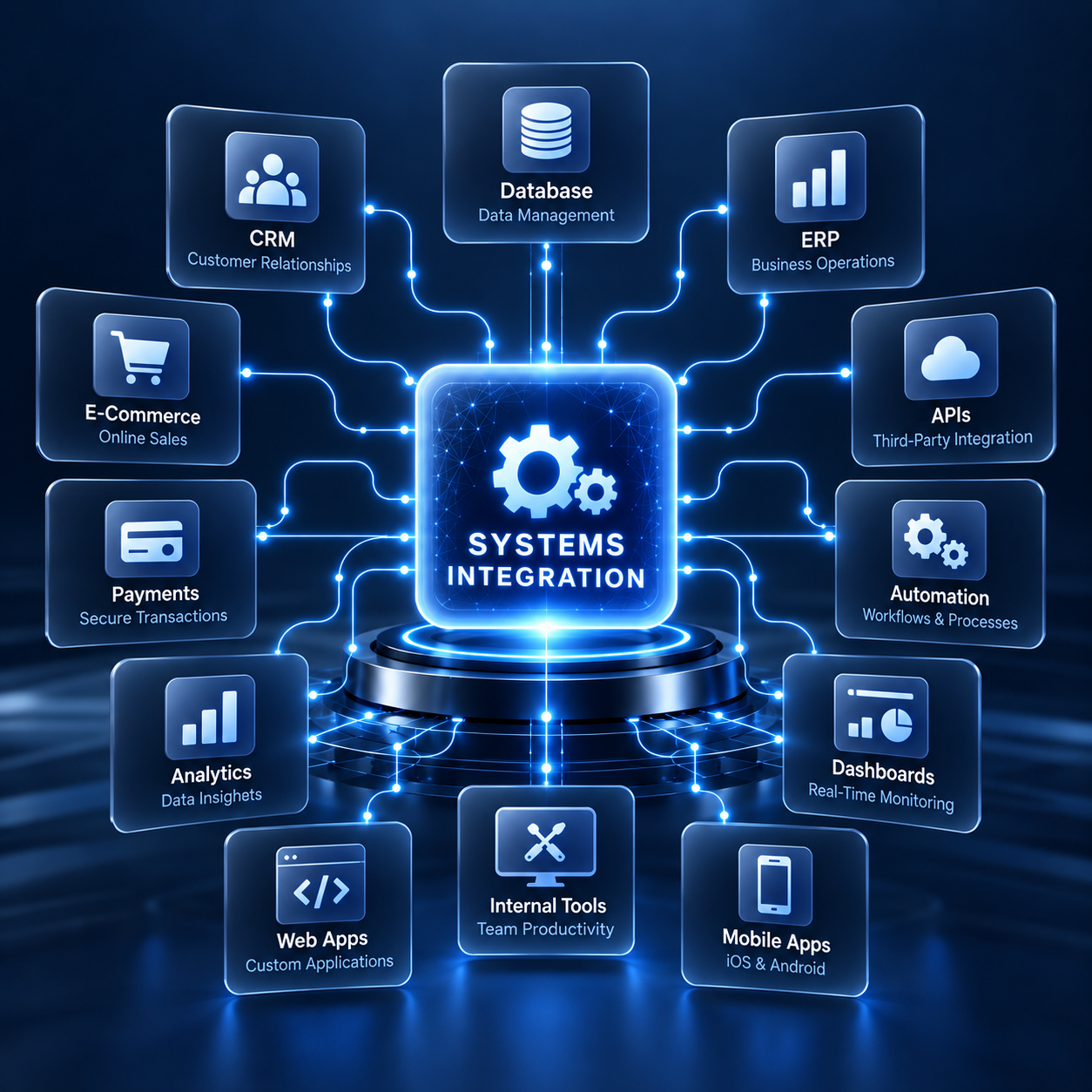
Connect existing applications, databases, operational platforms, and communication tools into a coordinated technology environment. We design integration workflows that define how information moves between systems, which application owns each record, and how exceptions are handled.Custom Data Processing Applications
Develop tools for transforming, validating, organizing, and processing business information from approved data sources. Applications can support structured imports and exports, data quality checks, scheduled processing, document workflows, and integration with business databases.AI-Enabled Business Applications
Integrate selected AI capabilities into custom software when they provide a practical operational benefit. Examples include document analysis, internal knowledge retrieval, enquiry classification, information extraction, summarization, and AI-assisted task execution with appropriate controls.Operational Dashboards & Reporting Tools
Build interfaces that combine data from relevant business sources to provide visibility into operations, workflow status, exceptions, and selected performance indicators. Dashboards can support managers and employees without requiring them to work directly with databases or technical integration tools.From Disconnected Applications to Connected Business Systems
Many companies already have the software they need for individual activities. The challenge is that these applications often operate independently. A CRM may contain customer information, an accounting application may manage invoices, a document platform may store agreements, and an operational system may track project delivery. When information must move between these tools manually, the business can experience duplicate work, inconsistent records, delayed updates, and limited operational visibility. FEELINNOVATIONS can design an integration architecture that connects the relevant applications and introduces dedicated software components where necessary. This may involve:- Identifying the authoritative source for important business data
- Defining how information should move between applications
- Developing APIs and application connectors
- Transforming and validating exchanged data
- Coordinating multi-step workflows
- Implementing error handling and processing logs
- Defining access permissions and operational controls
- Providing interfaces for employees and authorized users
Example: A Connected Operations Management Platform
Consider a project-based company that uses separate applications to manage customer enquiries, estimates, contracts, operational tasks, supplier information, and reporting. Employees may need to switch between several tools to understand the current status of a project or determine which action is required. A custom operations platform could provide a unified interface while preserving the company's existing specialized applications.Unified Project Workspace
Display authorized project information, responsible employees, important milestones, documents, and current operational status in one interface.Connected Business Records
Retrieve relevant customer, proposal, project, and operational information through supported integrations.Document Management Workflows
Organize approved project documents, track relevant versions or statuses, and connect document actions with operational processes.Task & Approval Coordination
Create tasks, route requests to responsible employees, and support defined approval steps.Automated System Updates
Exchange information between connected applications when specified business events occur, subject to validation and access controls.Operational Reporting
Provide selected dashboards and reports using available data from connected business systems. This is an illustrative solution architecture, not a claim about a completed FEELINNOVATIONS customer project.Custom Software vs. Off-the-Shelf Applications
Custom development is not automatically the best choice for every requirement. When an established software product already meets the business need reliably and economically, using or configuring that product may be more appropriate than building a replacement. Custom software becomes particularly relevant when:- The business requires functionality unavailable in existing products
- Several applications must work together under specific business rules
- Employees need a unified interface across disconnected tools
- Existing workflows require extensive manual workarounds
- Specialized data structures or processing logic are necessary
- There are important requirements for permissions, traceability, or integration
- The organization needs to own and extend dedicated application functionality
Engineering for Reliability & Maintainability
A business-critical application requires more than a functional demonstration. Depending on project scope and risk, technical architecture may include:- Documented application requirements and acceptance criteria
- Structured data models and database design
- Authentication and role-based authorization
- Secure handling of credentials and sensitive information
- Input validation and business rule enforcement
- API error handling and retry strategies
- Logging, monitoring, and operational alerts
- Automated testing and deployment procedures
- Backup and recovery requirements
- Technical documentation and handover
Technology Selected for the Project
FEELINNOVATIONS approaches technology as a means of solving a business problem rather than a fixed platform that every client must adopt.Python Development
Python can support backend services, custom data processing, APIs, business logic, integration components, and selected AI functionality.n8n Workflow Orchestration
n8n can coordinate application events, data exchanges, scheduled operations, and multi-step automation workflows.REST APIs & Webhooks
APIs and webhooks enable supported applications and services to exchange information and respond to authorized events.Databases & Data Architecture
Structured databases and appropriate data models support application records, relationships, processing history, and consistent information management.Cloud & Deployment Infrastructure
Hosting and deployment approaches are selected according to application requirements, operational needs, security expectations, and the client's environment.AI Models & Intelligent Components
AI capabilities can be integrated when suitable data access, evaluation procedures, and operational controls are available. Additional technologies and specialists may be required depending on the project's architecture and complexity.Who Can Benefit From Custom Business Systems?
Construction & Project-Based Businesses
Connect project information, estimates, customer records, operational tasks, documents, and reporting within tailored business applications.Professional Services & Agencies
Develop internal management platforms, client portals, approval workflows, reporting interfaces, and connected delivery systems.Sales & Commercial Operations
Build custom sales workspaces, integrate customer information, coordinate commercial workflows, and extend existing revenue execution systems.Logistics & Operational Services
Connect authorized operational data sources, coordinate internal tasks, and provide interfaces for tracking work and managing exceptions.Growing Small & Medium-Sized Businesses
Replace disconnected spreadsheets and manual workarounds with structured applications and integrations as operational requirements become more complex.Our Development Process
1. Requirements & Project Scope
We identify the business problem, intended users, required functionality, existing systems, constraints, and expected outcomes.2. Solution Architecture
We define the application components, data structures, interfaces, integration requirements, business rules, and relevant security controls.3. Development & Integration
We implement the agreed software functionality, databases, APIs, interfaces, and integrations using the selected technology stack.4. Testing & Validation
We validate representative use cases, integration behavior, permissions, data handling, and agreed acceptance criteria.5. Deployment & Handover
We prepare the application for its agreed hosting environment, provide technical documentation, and complete the agreed handover.6. Support & Further Development
Optional services may include maintenance, issue resolution, performance improvements, security updates, and additional functionality.What You Receive
Project deliverables are defined by the agreed scope and may include:- A working custom business application or integrated system
- Agreed user interfaces and application functionality
- Backend services and business logic
- Database structures and data processing components
- APIs and integrations with supported business applications
- Required authentication and access controls
- Testing and deployment
- Technical documentation and handover
- Optional maintenance and ongoing development